Taking out a loan is often easier than understanding exactly how much it will cost. You may know the amount you want to borrow and the interest rate offered by the lender, but that does not immediately tell you how much you will need to pay each month. Your monthly loan payment depends mainly on […]
Taking out a loan is often easier than understanding exactly how much it will cost.
You may know the amount you want to borrow and the interest rate offered by the lender, but that does not immediately tell you how much you will need to pay each month.
Your monthly loan payment depends mainly on three things: the amount borrowed, the interest rate and the length of the repayment period.
Understanding how these factors work together can help you compare loans, estimate whether a payment fits your budget and see how changing the loan term can affect the total cost.
This guide explains how monthly loan payments are calculated, what the formula means and how to estimate payments using a practical example.
What Is a Loan Payment?
A loan payment is the amount you pay to a lender according to your repayment agreement.
For a typical amortizing loan, each payment generally contains two important parts:
Principal is the portion that reduces the amount you borrowed.
Interest is the cost charged by the lender for lending you the money.
At the beginning of many amortizing loans, a larger portion of the payment goes toward interest. As the outstanding principal decreases, the interest portion generally becomes smaller and more of the payment goes toward principal.
This gradual repayment process is called amortization.
What Determines Your Monthly Loan Payment?
For a standard fixed-rate amortizing loan, three inputs have the greatest effect on the monthly principal-and-interest payment.
1. Loan Amount
The loan amount, or principal, is the amount of money you borrow.
If you borrow $10,000, your starting principal is $10,000.
Generally, borrowing more money results in a higher monthly payment when the interest rate and loan term remain the same.
2. Interest Rate
The interest rate represents the cost of borrowing money.
For example, a loan with a 7% annual interest rate will generally cost more than an otherwise identical loan with a 5% rate.
When calculating a standard monthly payment, the annual interest rate must first be converted into a monthly rate.
3. Loan Term
The loan term is the amount of time you have to repay the loan.
It may be expressed in months or years.
For example:
5 years = 60 monthly payments
10 years = 120 monthly payments
A longer repayment period can reduce the required monthly payment, but it can also increase the total interest paid because the balance remains outstanding for longer.
Monthly Loan Payment Formula
A commonly used formula for calculating the principal-and-interest payment on a fixed-rate amortizing loan is:
M = P × [r(1 + r)ⁿ] ÷ [(1 + r)ⁿ − 1]
Where:
M = monthly payment
P = principal or original loan amount
r = monthly interest rate
n = total number of monthly payments
The formula may look complicated at first, but it becomes easier when each value is calculated separately.
How to Calculate a Loan Payment Step by Step
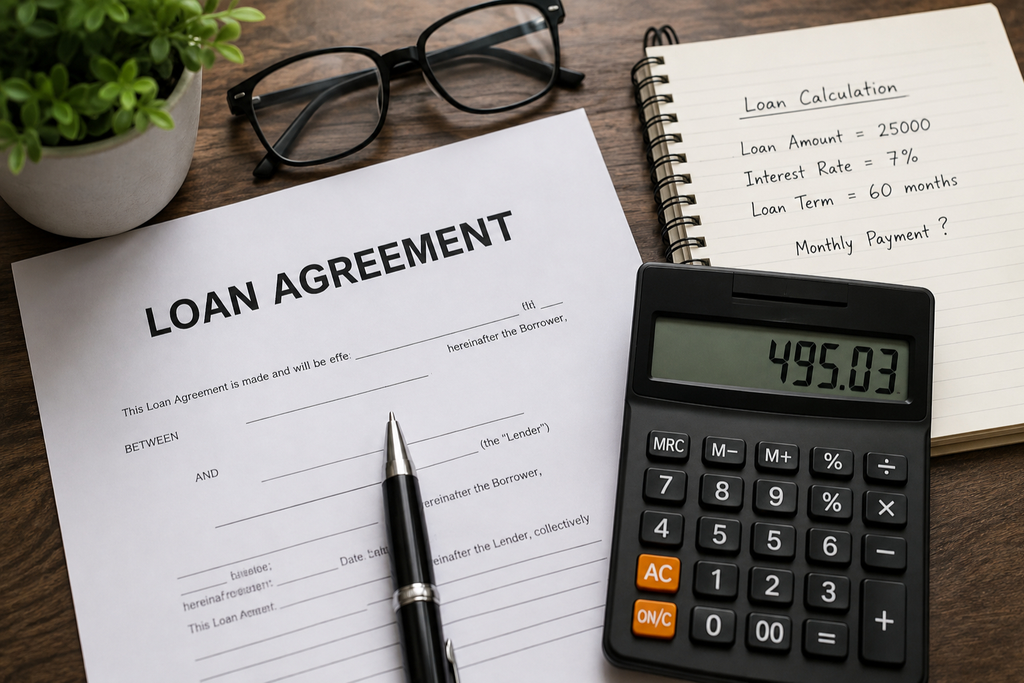
Suppose you borrow:
Loan amount: $25,000
Annual interest rate: 7%
Loan term: 5 years
Let’s calculate the estimated monthly principal-and-interest payment.
Step 1: Identify the Principal
The amount borrowed is $25,000.
Therefore:
P = 25,000
Step 2: Convert the Annual Interest Rate to a Monthly Rate
The annual rate is 7%.
First convert the percentage into a decimal:
7 ÷ 100 = 0.07
Then divide it by 12:
0.07 ÷ 12 = 0.0058333
Therefore:
r ≈ 0.0058333
Step 3: Calculate the Number of Payments
The loan lasts five years and payments are monthly.
5 × 12 = 60
Therefore:
n = 60
Step 4: Enter the Values Into the Formula
Now use:
M = P × [r(1 + r)ⁿ] ÷ [(1 + r)ⁿ − 1]
Using:
P = 25,000
r = 0.0058333
n = 60
The estimated payment is approximately:
$495.03 per month
This represents the estimated monthly principal-and-interest payment under these assumptions.
Over 60 payments:
$495.03 × 60 ≈ $29,701.80
Subtract the original $25,000 principal:
Estimated total interest ≈ $4,701.80
Small differences can occur because of rounding and because actual lenders may calculate interest or payment timing differently.
Use a Loan Calculator Instead
You do not need to calculate the formula manually every time.
Use the Calqoras Loan Calculator to enter your loan amount, interest rate and loan term and quickly estimate the payment.
A calculator is particularly useful when comparing several scenarios.
For example, you can change the interest rate from 7% to 6%, extend the repayment period or reduce the amount borrowed and immediately see how the estimated payment changes.
Manual calculations are still useful because they help you understand what is happening behind the result.
How Interest Rates Affect Loan Payments
Interest rates can make a meaningful difference to both the monthly payment and the total cost of borrowing.
Suppose two borrowers take loans for exactly the same amount and repayment period.
If one receives a lower interest rate, that borrower will generally have a lower required payment and pay less interest, assuming all other loan terms are identical.
This is why comparing loans only by the amount a lender is willing to provide can be misleading.
The cost of borrowing matters too.
When reviewing an offer, look carefully at the interest rate, APR where applicable, fees, repayment period and total amount you are expected to repay.
How the Loan Term Affects Your Payment
The repayment period creates an important tradeoff.
A shorter loan term usually means higher monthly payments but can result in less total interest.
A longer loan term usually lowers the required monthly payment but can increase the total interest paid.
Imagine spreading the same amount of money across 36 payments instead of 72.
The 72-payment option gives you more time to repay the balance, so each required payment can be smaller. However, the loan also remains outstanding for much longer.
That is why the lowest monthly payment is not automatically the cheapest loan.
When comparing options, consider both:
Can I comfortably afford the monthly payment?
and
How much will this loan cost me overall?
Principal vs Interest
Understanding the difference between principal and interest makes loan payments much easier to understand.
Suppose you still owe $20,000.
Your payment does not necessarily reduce that balance by the full amount of the payment. Part of the payment may first cover interest and applicable charges, with the remaining portion reducing principal according to the loan agreement.
With many amortizing loans, the interest portion is larger near the beginning because the outstanding balance is higher.
As principal is repaid, the balance falls. With less outstanding principal on which to calculate interest, more of later payments can go toward reducing the balance.
What Is an Amortization Schedule?
An amortization schedule shows how payments are distributed throughout the life of an amortizing loan.
Depending on the loan, a schedule may show:
- payment number
- payment amount
- interest paid
- principal paid
- remaining balance
This can help explain something that sometimes surprises borrowers: making several payments does not necessarily mean the balance has fallen by the sum of those payments.
Part of the money has been used to pay interest.
As the loan progresses, the relationship between principal and interest changes.
Fixed-Rate vs Variable-Rate Loans
The standard payment formula works particularly well for a conventional fixed-rate amortizing loan.
A fixed-rate loan keeps the stated interest rate unchanged for the agreed fixed-rate period, making scheduled principal-and-interest payments more predictable.
A variable or adjustable-rate loan can work differently because the interest rate may change according to the loan terms.
If the rate changes, the required payment may also change.
For this reason, do not assume that a payment calculated using today’s interest rate will remain unchanged for the entire life of a variable-rate loan.
Read the actual loan agreement to understand how and when adjustments can occur.
What About a 0% Interest Loan?
The standard amortization formula requires special handling when the interest rate is zero because the monthly interest rate becomes zero.
For a genuine 0% loan with no other financing charges included in the calculation, the basic payment calculation is much simpler:
Monthly Payment = Loan Amount ÷ Number of Payments
For example, borrowing $12,000 and repaying it over 24 equal monthly payments would give:
$12,000 ÷ 24 = $500 per month
However, always check the loan terms for fees, deferred-interest conditions or other charges.
Monthly Payment vs Total Loan Cost
A common mistake is focusing entirely on the monthly payment.
Suppose a lender offers to reduce your monthly payment by extending the loan term.
That might help your monthly budget, but it does not necessarily make the loan cheaper.
The longer repayment period can cause you to pay interest for additional months or years.
When comparing loans, consider at least:
Monthly payment — what you need to pay regularly.
Total interest — how much borrowing costs through interest over the repayment period.
Total repayment — the total amount paid across all scheduled payments.
Fees and other charges — costs that may not be captured by a basic principal-and-interest calculation.
Looking at these together gives a clearer picture than monthly payment alone.
Does APR Affect the Calculation?
Interest rate and annual percentage rate (APR) are related but are not always identical.
The interest rate generally represents the cost charged for borrowing the principal, while APR may provide a broader measure of borrowing cost by incorporating certain additional charges, depending on the type of credit and applicable rules.
Do not automatically substitute APR for the stated interest rate in a payment formula unless that is appropriate for the calculation you are performing.
When comparing actual loan offers, review the lender’s disclosures rather than relying solely on a generic calculator.
Can Paying Extra Reduce Loan Interest?
For many loans, paying down principal faster can reduce future interest because there is less outstanding principal on which interest can accrue.
However, the exact result depends on the loan agreement and how additional payments are applied.
Before making extra payments, check whether the loan has prepayment penalties and how the lender applies amounts paid above the required payment.
A calculator can model a basic extra-payment scenario, but the lender’s contract determines what actually happens.
Why Your Actual Payment May Differ From a Calculator
A loan calculator provides an estimate based on the information entered.
Your lender’s actual payment may differ because a real loan can include factors such as:
- origination or financing fees
- insurance
- taxes
- payment timing
- rounding methods
- variable interest rates
- introductory rates
- balloon payments
- lender-specific terms
Mortgage payments are an especially important example. The calculated principal-and-interest payment may not equal the total amount due each month because taxes, homeowners insurance, mortgage insurance or other costs may also be included.
Therefore, use calculator results for planning and comparison rather than treating them as a lender’s final quote.
Common Loan Calculation Mistakes
Using the Annual Rate as the Monthly Rate
If a loan has a 6% annual interest rate, you normally cannot enter 0.06 directly as the monthly rate in the standard monthly-payment formula.
For a conventional calculation, the annual nominal rate is typically divided by 12 first.
Forgetting to Convert Years Into Months
A five-year monthly loan has 60 scheduled payments, not five.
Looking Only at the Monthly Payment
A smaller payment can look attractive while hiding a much longer repayment period and higher total interest.
Ignoring Fees
A simple calculator may calculate principal and interest but not every fee associated with a real loan.
Assuming Every Loan Uses the Same Formula
Not every credit product is a standard fixed-rate amortizing loan.
Some loans use variable rates, interest-only periods, balloon payments, income-based repayment structures or other arrangements.
Always check the terms of the specific loan.
How to Compare Two Loan Offers
Suppose you are considering two lenders.
Do not simply ask which one offers the lower monthly payment.
Compare the same borrowing amount and consider:
- Interest rate
- APR where applicable
- Loan term
- Required monthly payment
- Total estimated interest
- Fees
- Total repayment
- Prepayment conditions
- Whether the rate is fixed or variable
A slightly higher monthly payment can sometimes correspond to a lower overall borrowing cost if it allows the loan to be repaid sooner.
Frequently Asked Questions
How do I calculate a monthly loan payment?
For a standard fixed-rate amortizing loan, you can use the formula:
M = P × [r(1 + r)ⁿ] ÷ [(1 + r)ⁿ − 1]
P represents principal, r represents the monthly interest rate and n represents the number of monthly payments.
What are the main factors affecting a loan payment?
The three main inputs are the amount borrowed, interest rate and repayment term. Fees and the specific structure of the loan can also affect the actual amount due.
Does a longer loan term reduce the monthly payment?
Generally, yes, when the other terms remain unchanged. Spreading repayment across more months usually reduces each required payment. However, it can increase the total interest paid.
Does a lower interest rate always mean a cheaper loan?
A lower rate can reduce borrowing costs when other terms are equal, but rates should not be considered alone. Fees, repayment periods and other conditions can affect the total cost.
What is the difference between principal and interest?
Principal is the amount borrowed or the remaining amount owed. Interest is the cost charged for borrowing the money.
Why does more of my payment go toward interest at the beginning?
For many amortizing loans, interest is calculated using the outstanding balance. Because the balance is larger near the beginning, the interest portion is generally larger. As principal decreases, the interest portion can decline.
Can I calculate a loan payment without a calculator?
Yes. You can calculate it manually using the amortization formula, although a loan calculator makes it faster and reduces the chance of arithmetic errors.
Is a loan calculator completely accurate?
It can accurately calculate the mathematical scenario entered, but it cannot know every term of a real loan unless those terms are included. Actual lender payments may include fees, insurance, taxes or other conditions.
Final Thoughts
Calculating a loan payment is about more than finding one monthly number.
The loan amount tells you how much you are borrowing. The interest rate affects the cost of borrowing, and the loan term determines how long repayment is spread out.
Understanding all three makes it easier to compare borrowing options and recognize the tradeoff between a lower monthly payment and the total amount paid over time.
Before agreeing to a loan, compare the monthly payment, interest, fees, repayment period and total cost rather than relying on a single figure.
For a quick estimate, use the Calqoras Loan Calculator to test different loan amounts, rates and terms before comparing the result with the terms provided by your lender.
References
Consumer Financial Protection Bureau (CFPB), How do mortgage lenders calculate monthly payments?
Consumer Financial Protection Bureau (CFPB), What is amortization and how could it affect my auto loan?
Consumer Financial Protection Bureau (CFPB), How does paying down a mortgage work?
Editorial note: Calculator results and examples are educational estimates. Actual loan terms, payments, fees and interest calculations can vary by lender and loan agreement. Calqoras does not provide lending, financial or legal advice.
This article is general educational information prepared by the Calqoras Editorial Team. Verify important figures independently and consult a qualified professional where appropriate.
Read our Editorial Policy →