
📓 Lab Notebook Tips Calculator
Dilution, concentration conversion, molarity & solution prep — Document every calculation in your lab notebook
📓 LAB NOTEBOOK TIP
Always document every calculation in your lab notebook. Record the date, experiment title, reagent lot numbers, instrument IDs, all input values, the formula used, every intermediate step, and the final result. Sign and date each entry. Use permanent ink—never pencil. If you make an error, draw a single line through it, write the correction, and initial it. These lab notebook tips ensure your work is reproducible, auditable, and defensible. Per good laboratory practice (GLP), calculations should be independently verified for critical experiments.
🔗 You Might Also Need
🕐 Calculation History
Lab Notebook Tips: Essential Documentation, Calculations & Best Practices for Every Researcher
Lab notebook tips are the foundation of reproducible, defensible, and auditable scientific research. A well-maintained lab notebook records every experiment with date, title, objective, materials (with lot numbers), methods, calculations (showing every step), results, observations, and conclusions—signed and dated on the same day. According to the National Institutes of Health (NIH) and the American Chemical Society (ACS), good lab notebook practices include using permanent ink, never erasing errors (draw a single line and initial), recording data contemporaneously, and having entries witnessed by a colleague. This lab notebook tips calculator helps researchers perform and document the four most common lab calculations: dilutions (C₁V₁ = C₂V₂), concentration unit conversions, molarity calculations, and solution preparation—each with step-by-step working ready for notebook entry.
YOUR LAB NOTEBOOK IS A LEGAL DOCUMENT. It serves as evidence of invention (patent applications), proof of data integrity (regulatory audits), and the basis for reproducibility (peer review). Never use pencil—use permanent ink. Never erase—draw a single line through errors, write the correction, and initial it. Record data at the time of the experiment (contemporaneously)—never transcribe from scratch paper later. Include lot numbers, instrument IDs, and environmental conditions when relevant. Have a colleague witness and sign critical entries. These lab notebook tips protect your research, your reputation, and your institution.
📋 Table of Contents
▼What Lab Notebook Tips Cover
Lab notebook tips are a collection of best practices for documenting scientific experiments, calculations, observations, and conclusions in a bound, paginated notebook (or validated electronic lab notebook). According to the American Chemical Society, a lab notebook should contain enough detail that a competent colleague could reproduce the experiment from the notebook alone. Lab notebook tips cover what to write (date, title, objective, materials, methods, calculations, results, conclusions), how to write it (permanent ink, contemporaneous recording, error correction), and how to verify it (witnessed entries, cross-referenced data).
Lab notebook tips tell you exactly how to document every experiment so that your work is reproducible, defensible, and auditable. Unlike general writing advice, these lab notebook tips are specifically designed for scientific research and include features unique to laboratory documentation: calculation documentation (showing every step from formula to final answer), reagent tracking (lot numbers, purity, source), instrument logs (model, serial number, calibration status), and data integrity practices (ALCOA+ principles). Every researcher—from undergraduate students to principal investigators to pharmaceutical scientists—relies on lab notebook tips to maintain the quality and integrity of their research records.
The reason lab notebook documentation trips people up is not the science itself but the documentation habits. A researcher may perform a perfect dilution but fail to record the lot number of the stock solution, making the experiment irreproducible. A student may calculate the correct molarity but write only the final answer without showing the working, making it impossible to verify. A postdoc may record data on scratch paper and transcribe it later, violating the contemporaneous recording principle. The lab notebook tips calculator addresses these issues by performing the calculation AND displaying every step in a format ready for notebook entry—including prompts for lot numbers, instrument IDs, and signatures.
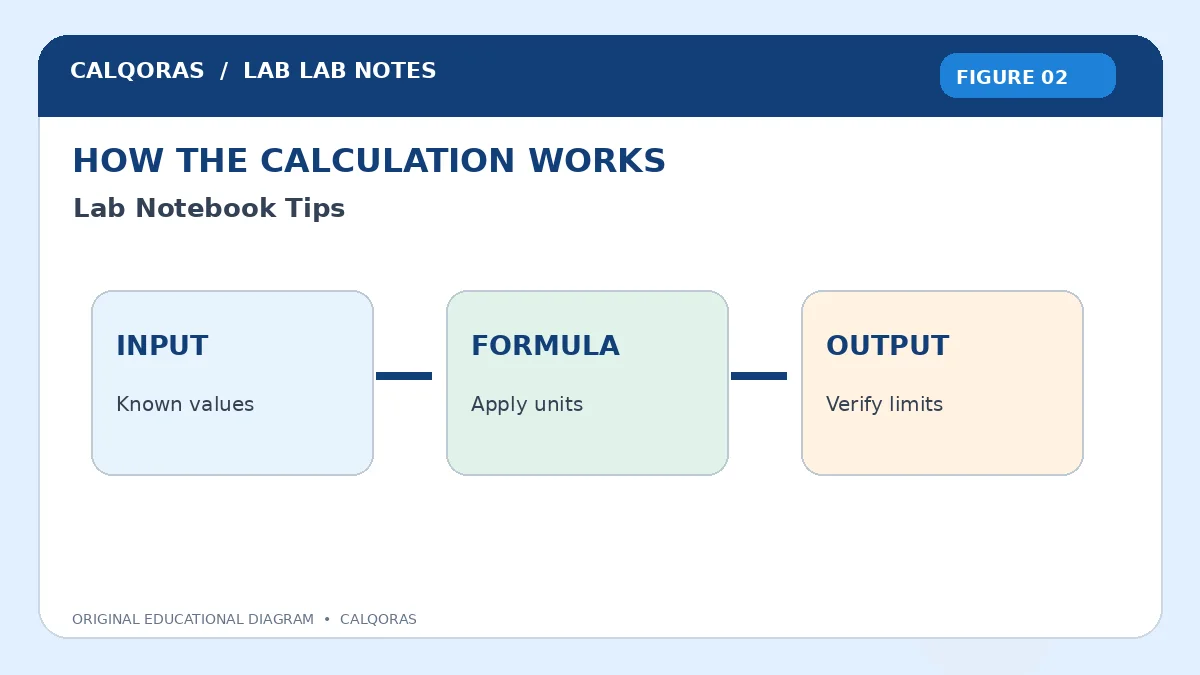
This lab notebook tips calculator handles the four most common laboratory calculations in one place: dilution (C₁V₁ = C₂V₂), concentration unit conversion, molarity calculation, and solution preparation. Each mode shows the answer and every step of the working, so you can copy the calculation directly into your lab notebook, verify the reasoning, teach a student, or document the calculation for a patent application.
Whether you are an undergraduate recording your first organic synthesis, a PhD student documenting a Western blot, a pharmaceutical scientist filing an IND application, or a QA manager auditing lab records, these lab notebook tips give you the framework to document every experiment correctly—every time.
How Lab Notebook Documentation Works
Every lab notebook entry comes down to one idea: a competent colleague should be able to reproduce your experiment from the notebook alone, without asking you a single question. From that single principle, a handful of lab notebook tips cover almost every documentation task. The lab notebook tips calculator exists to handle the calculation side of documentation reliably and transparently, because in practice the “arithmetic” is layered with unit conversions, reagent tracking, and data integrity requirements—and any one of them, applied wrongly or omitted, can produce an irreproducible experiment or a failed patent application.
The Essential Lab Notebook Entry Structure
Every lab notebook entry should follow a consistent structure: Date, Title, Objective, Materials (with lot numbers), Methods (step-by-step), Calculations (showing every step), Results (raw data), Observations (what you saw, heard, smelled), Conclusions (what it means), and Signature (with date). The lab notebook tips calculator generates the Calculations section with every step displayed, ready to copy into your notebook.
Molarity: M = Mass (g) ÷ (MW × Volume (L))
Solution Prep: Solute (g) = (% × Volume mL) ÷ 100
Conversion: 1 mg/mL = 1000 µg/mL = 1 g/L = 0.1% = 1000 ppm
Why Calculations Must Show Every Step
One of the most important lab notebook tips is to show every step of every calculation. Writing only the final answer makes it impossible to verify the work, catch errors, or defend the result in a patent dispute. The lab notebook tips calculator displays every intermediate step—from formula to substitution to final answer—so you can copy the complete calculation into your notebook. This practice is required by GLP (Good Laboratory Practice), GMP (Good Manufacturing Practice), and most peer-reviewed journals.
Concentration Unit Conversions
Lab notebook tips always include unit conversion reference tables. The most common conversions are: 1 mg/mL = 1000 µg/mL = 1 g/L = 0.1% w/v = 1000 ppm (for aqueous solutions). Molar conversions require the molecular weight: Molarity (M) = Mass (g) ÷ (MW (g/mol) × Volume (L)). The lab notebook tips calculator handles all of these conversions internally and displays the conversion factors in the step-by-step solution.
Quick Reference Values for Lab Notebook Tips
Remember: The lab notebook tips calculator provides the calculation, but you must record it in your notebook. Copy every step, include the date, experiment title, reagent lot numbers, instrument IDs, and your signature. Have a colleague witness critical entries weekly. These lab notebook tips ensure your work is reproducible, defensible, and auditable.
Real Scenarios Where Lab Notebook Tips Mattered
These scenarios reflect real research situations where lab notebook tips—or the lack of them—made a tangible difference to patent outcomes, reproducibility, and career trajectories. Each scenario shows how proper lab notebook tips would have prevented the problem.
Scenario 1: The Patent That Failed Because of Poor Documentation
A pharmaceutical company filed a patent application for a novel drug formulation. During litigation, the opposing party challenged the priority date, arguing the invention was not actually reduced to practice on the claimed date. The company’s lab notebook entry for the key experiment lacked a date, had no witness signature, and showed only the final result without calculations. The court ruled the notebook entry was insufficient evidence, and the company lost priority—costing them an estimated $200 million in patent value. Proper lab notebook tips (dated, witnessed, step-by-step calculations) would have secured the priority date.
Scenario 2: The Irreproducible Experiment
A graduate student published a high-impact paper describing a novel protein purification protocol. When three other labs tried to reproduce the work, they failed. Investigation revealed the student’s lab notebook lacked critical details: the exact concentration of the elution buffer (written as “~1 M” instead of the calculated value), the lot number of the affinity resin, and the pH calibration date. The paper was retracted. These lab notebook tips—recording exact values, lot numbers, and calibration status—would have made the protocol reproducible.
Scenario 3: The Dilution Error Hidden by Missing Steps
A researcher prepared a 10 µM working solution from a 1 mM stock for a cell culture experiment. The lab notebook showed only “10 µM solution prepared” without calculations. The actual dilution was performed incorrectly (1:10 instead of 1:100), producing a 100 µM solution that killed the cells. Without the calculation steps in the notebook, the error could not be traced, and the researcher spent three months troubleshooting before discovering the dilution error. These lab notebook tips—showing every calculation step—would have caught the error immediately.
Scenario 4: The Data Integrity Violation
During an FDA audit of a pharmaceutical QC lab, the auditor discovered that analysts were recording HPLC results on scratch paper and transcribing them into the lab notebook at the end of the day. This violated the contemporaneous recording requirement of 21 CFR Part 11 and GLP guidelines. The lab received a Warning Letter, and all data from the past year had to be re-verified. These lab notebook tips—record data at the time of the experiment, never transcribe—would have prevented the violation.
Scenario 5: The Molarity Error Without MW Documentation
A postdoc prepared a 0.5 M NaCl solution but recorded only “0.5 M NaCl” in the lab notebook, without documenting the molecular weight used (58.44 g/mol) or the mass weighed (29.22 g in 1 L). When a colleague tried to reproduce the solution six months later, they used the wrong MW (from a different hydrate form), producing a solution with the wrong concentration. These lab notebook tips—documenting MW source, mass weighed, and final volume—would have prevented the error.
Scenario 6: The Solution Prepared in Wrong Units
A technician prepared a “5% NaOH solution” but used the % w/v formula (5 g per 100 mL) when the SOP specified % w/w (5 g per 100 g solution). The lab notebook entry said “5% NaOH” without specifying w/v or w/w, and the calculation was not shown. The cleaning solution was ineffective, and equipment was not properly sanitized. These lab notebook tips—always specify the concentration type (% w/v, % v/v, or % w/w) and show the calculation—would have prevented the confusion.
Scenario 7: The Missing Lot Number
A research lab discovered that a series of experiments produced inconsistent results over several months. Investigation revealed that the antibody used in the experiments had been replaced with a new lot, but the lab notebook entries did not record lot numbers. The new lot had different specificity, producing false-positive results in 40% of the experiments. These lab notebook tips—always record reagent lot numbers—would have immediately identified the source of the inconsistency.
Scenario 8: The Unwitnessed Invention
A researcher conceived a novel catalyst design and documented the experiment in her lab notebook. However, the notebook was never witnessed by a colleague. When a competing lab published the same catalyst 18 months later, the researcher could not prove priority because her notebook lacked witness signatures. The competing lab’s notebook was properly witnessed, and they received the patent. These lab notebook tips—have entries witnessed weekly—are essential for protecting intellectual property.
Common Lab Notebook Mistakes
The errors researchers make in lab notebooks cluster around a few predictable points. Understanding why they happen—and how these lab notebook tips prevent them—is the key to consistent, defensible documentation.
Mistake 1: Using Pencil or Erasable Ink
Writing in pencil or erasable ink allows entries to be altered after the fact, destroying the legal integrity of the notebook. These lab notebook tips always specify permanent ink—blue or black—and never pencil. If you make an error, draw a single line through it, write the correction, and initial it.
Mistake 2: Recording Only Final Answers
Writing only the final answer without showing the calculation makes it impossible to verify the work, catch errors, or defend the result. These lab notebook tips require showing every step: formula, substitution, intermediate values, and final answer. The lab notebook tips calculator generates this step-by-step format automatically.
Mistake 3: Transcribing Data Later
Recording data on scratch paper and transcribing it into the notebook later violates the contemporaneous recording requirement. These lab notebook tips require recording data directly in the notebook at the time of the experiment. If you must use scratch paper (e.g., for a quick calculation), tape or staple it into the notebook and reference it.
Mistake 4: Omitting Lot Numbers
Failing to record reagent lot numbers makes experiments irreproducible when reagents change. These lab notebook tips require recording lot numbers for every reagent, antibody, buffer, and consumable used in the experiment.
Mistake 5: Not Dating Entries
Undated entries have no legal standing for patent priority or data integrity. These lab notebook tips require dating every entry at the time of writing—not at the end of the week or month.
Mistake 6: Skipping Witness Signatures
Unwitnessed entries are weak evidence in patent disputes. These lab notebook tips require having a colleague (who understands the science) review and sign entries weekly. The witness signs “Read and understood” with date.
Mistake 7: Leaving Blank Spaces
Blank spaces in a lab notebook can be filled in later, raising data integrity concerns. These lab notebook tips require drawing a line through any blank space at the end of an entry or page, preventing retroactive additions.
💡 Rule of Thumb: Always use permanent ink, show every calculation step with the lab notebook tips calculator, record data contemporaneously, include lot numbers and instrument IDs, date every entry, get weekly witness signatures, and draw lines through blank spaces. These lab notebook tips protect your research, your patents, and your career.
Expert Perspectives on Lab Notebook Tips
The researchers and legal professionals who work with lab notebooks daily share consistent advice about what separates excellent documentation from career-damaging errors—and how these lab notebook tips help prevent them.
“In 20 years of patent litigation, I have seen cases worth hundreds of millions of dollars won or lost on the quality of a lab notebook. The entries that hold up in court are dated, witnessed, show every calculation step, and include lot numbers. These lab notebook tips are not optional—they are the difference between a $200 million patent and a worthless piece of paper.”
“The most common reason experiments fail to reproduce is incomplete documentation. A protocol that says ‘add buffer’ without specifying the concentration, pH, and lot number is useless. I require every student in my lab to follow these lab notebook tips from day one—and I review notebooks weekly. The lab notebook tips calculator makes the calculation documentation effortless.”
“During FDA audits, the first thing we check is whether data was recorded contemporaneously. Scratch paper transcribed later is an immediate red flag. These lab notebook tips—record directly in the notebook, never transcribe—are non-negotiable in regulated environments.”
“I trained over 500 new hires in our pharmaceutical R&D lab, and the number one documentation error was omitting calculation steps. The lab notebook tips calculator solves this by generating every step automatically. I recommend it to every new scientist on their first day.”
Frequently Asked Questions About Lab Notebook Tips
These questions come from students, researchers, and lab professionals who want to improve their documentation using these lab notebook tips.
These lab notebook tips require documenting enough detail that a competent colleague could reproduce the experiment without asking questions. The lab notebook tips calculator generates the Calculations section with every step displayed.
These lab notebook tips require permanent ink for all entries. If you make an error, draw a single line through it, write the correction nearby, and initial it with the date.
These lab notebook tips preserve the audit trail—the original entry remains visible, and the correction is attributed to you with a date.
These lab notebook tips recommend weekly witnessing for academic research and daily witnessing for patent-critical experiments in industry.
These lab notebook tips require contemporaneous recording—data should be recorded at the time of the experiment, not transcribed later from memory.
The lab notebook tips calculator generates this format automatically: formula, substitution, intermediate steps, and final answer—ready to copy into your notebook.
These lab notebook tips support all ALCOA+ principles: attributable (signed entries), legible (permanent ink), contemporaneous (recorded same day), original (first recording), and accurate (verified calculations).
These lab notebook tips recommend storing notebooks in a secure, climate-controlled location with a catalog system for retrieval.
These lab notebook tips apply to both formats: permanent records, contemporaneous entries, witnessed signatures, and complete calculations.
Copy the step-by-step solution directly into your lab notebook, fill in the lot numbers and instrument IDs, sign and date, and have a colleague witness it. These lab notebook tips make documentation fast, accurate, and complete.
Lab Notebook Tips Best Practices
These lab notebook tips separate excellent documentation from career-damaging errors. Follow them alongside the lab notebook tips calculator for consistent, defensible records.
Before the Experiment
During the Experiment
After the Experiment
Trusted Reference Resources
These are authoritative references for lab notebook tips and scientific documentation best practices.
American Chemical Society — Lab Notebook Guidelines — acs.org — ACS guidelines for maintaining laboratory notebooks in academic and industrial research settings.
NIH — Research Data Management — nih.gov — NIH policies on data integrity, documentation, and research record retention for federally funded research.
FDA — 21 CFR Part 11 (Electronic Records) — fda.gov — FDA regulations for electronic records and signatures, including electronic lab notebook requirements.
USPTO — Patent Documentation Requirements — uspto.gov — US Patent and Trademark Office requirements for lab notebook documentation in patent applications and litigation.
Nature — Reporting Standards — nature.com — Nature journal’s reporting standards for experimental methods, including documentation requirements for reproducibility.
On our platform, related calculation tools that complement these lab notebook tips include: solution dilution calculator, molarity dilution calculator, molecular weight calculator, C1V1 dilution calculator, dilution factor calculator, buffer calculator, PPM calculator, micromolar calculator, percent concentration calculator, and dilution calculator (all-in-one).
Leave a Review
Used these lab notebook tips and the lab notebook tips calculator in your research? Share your experience below. Your review helps other researchers improve their documentation. Every review is stored locally on your device and appears instantly.
📝 Share Your Experience
Final Thoughts on Lab Notebook Tips
Lab notebook documentation is one of those skills that seems straightforward until patent disputes, reproducibility crises, regulatory audits, and career-defining moments all depend on the quality of your records. The science may be brilliant, but without proper documentation—dated, witnessed, step-by-step, with lot numbers and instrument IDs—it is legally invisible and scientifically irreproducible. These lab notebook tips exist to remove that documentation risk, providing a framework that makes every experiment recordable, verifiable, and defensible.
What separates excellent documentation from career-damaging errors is discipline, not genius. Using permanent ink, showing every calculation step with the lab notebook tips calculator, recording data contemporaneously, including lot numbers and instrument IDs, dating every entry, getting weekly witness signatures, and drawing lines through blank spaces: these are the habits that protect your research, your patents, and your reputation. The lab notebook tips calculator does the maths perfectly every time and displays every step, but it cannot date the entry, sign it, or witness it—that remains the researcher’s responsibility.
The framework is short: calculate with the lab notebook tips calculator, copy every step into your notebook, record lot numbers and instrument IDs, sign and date, and get a witness signature. That sequence gives defensible documentation every time. From undergraduate labs and PhD research to pharmaceutical R&D and patent litigation, proper lab notebook documentation is the foundation of scientific integrity, and following these lab notebook tips is one of the most consequential habits in a research career.
Keep these lab notebook tips handy as your starting point for every experiment, and use the related calculation tools in the sidebar whenever you need to perform or verify a calculation before documenting it in your notebook.
🔒 Privacy Guarantee: Every calculation on this lab notebook tips calculator page runs entirely within your browser. No data—concentrations, volumes, masses, or any other inputs—is sent to any server, stored, or shared. Your calculations are completely private and suitable for use in patent-sensitive research.