
🌱 Plant Care Calculator
Calculate fertilizer dilutions, watering needs, soil pH adjustments & pest control solutions
🌱 Plant Care Safety Note
Always follow product label instructions when using fertilizers and pesticides. Wear protective gloves when handling concentrated solutions. Test any new treatment on a small area first. Never mix different chemicals unless specifically instructed. Keep all plant care products out of reach of children and pets.
Calculation History
💡 You Might Also Like
Plant Care Calculator: Fertilizer Dilution, Watering, Soil pH & Pest Control Calculator
A plant care calculator is an essential tool that helps gardeners and plant enthusiasts accurately calculate fertilizer dilutions, watering amounts, soil pH adjustments, and pest control solutions. Using the C₁V₁ = C₂V₂ dilution formula and plant-specific guidelines, this calculator ensures precise measurements for healthy plant growth. Whether you’re diluting concentrated fertilizers, determining watering schedules based on pot size and plant type, adjusting soil pH with lime or sulfur, or mixing pest control solutions, this plant care calculator provides accurate calculations with step-by-step explanations for optimal plant care.
ALWAYS FOLLOW PRODUCT LABEL INSTRUCTIONS. When using fertilizers and pesticides, wear protective gloves and eyewear. Never mix different chemicals unless specifically instructed on the label. Test any new treatment on a small area first. Keep all plant care products out of reach of children and pets. Over-fertilization can burn plants and harm the environment. Always water plants before applying fertilizers to prevent root burn. This calculator provides mathematical guidance only—always verify with product labels and local extension services.
📋 Table of Contents
▼What a Plant Care Calculator Does
A plant care calculator is a specialized tool that performs essential calculations for plant maintenance, including fertilizer dilution (using C₁V₁ = C₂V₂ formula), watering requirements based on pot size and plant type, soil pH adjustment calculations (lime/sulfur amounts), and pest control solution dilutions. According to the National Gardening Association, proper dilution and application of plant care products is crucial for plant health and environmental safety.
A plant care calculator tells you exactly how much fertilizer to dilute, how much water your plants need, how to adjust soil pH, and how to mix pest control solutions safely. Unlike guesswork or rough estimates, a plant care calculator uses precise formulas and plant-specific guidelines to ensure optimal results. Every home gardener, commercial grower, and plant enthusiast who wants healthy plants relies on these calculations daily, and the plant care calculator exists to make them fast, accurate, and educational.
The reason plant care calculations trip people up is not the arithmetic itself but the multiple variables, unit conversions, and plant-specific requirements. A tropical plant needs different watering than a succulent. A flowering plant needs different fertilizer concentration than a seedling. Acid-loving plants need different soil pH than alkaline-preferring plants. The plant care calculator handles all of these scenarios internally so you can focus on growing healthy plants rather than doing complex math.
This plant care calculator handles the four most common plant care calculation tasks in one place: fertilizer dilution (concentrated to working strength), watering requirements (based on pot size, plant type, season, and drainage), soil pH adjustment (lime to raise pH, sulfur to lower pH), and pest control dilution (safe and effective concentrations). Each mode shows the answer and every step of the working, so you can verify the reasoning, learn the science, or document the calculation for your garden journal.
Whether you are a beginner gardener mixing your first fertilizer, an experienced grower optimizing plant nutrition, a landscaper managing large-scale plantings, or a plant parent trying to save a struggling houseplant, the plant care calculator gives you the exact calculations every time—no guesswork, no plant damage, no wasted products.
How Plant Care Calculations Work
Every plant care calculation comes down to one idea: providing plants with the right concentration of nutrients, water, and treatments for optimal growth. From that single principle, a handful of formulas cover almost every plant care calculation task. The plant care calculator exists to handle those formulas reliably and transparently, because in practice the “arithmetic” is layered with unit conversions, plant-specific requirements, and safety considerations—and any one of them, applied wrongly, can harm plants or waste resources.
Understanding Fertilizer Dilution
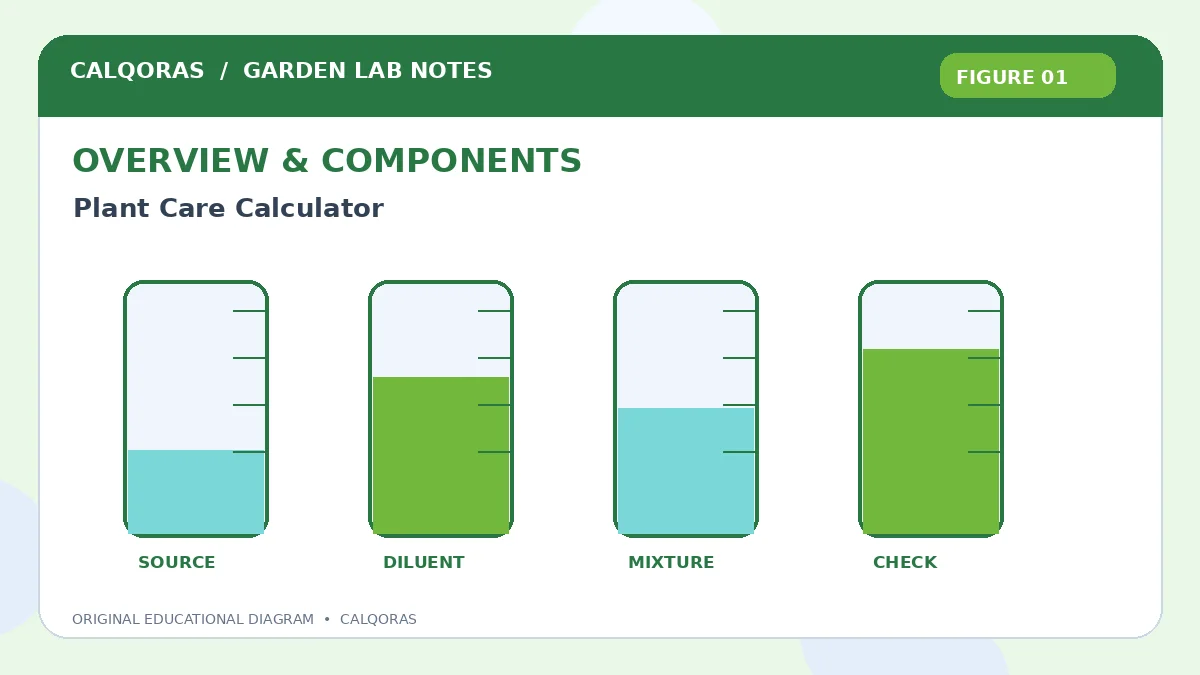
Fertilizer dilution is the process of mixing concentrated fertilizer with water to create a working solution that plants can safely absorb. The plant care calculator uses the standard dilution formula: C₁V₁ = C₂V₂, where C₁ is the stock concentration, V₁ is the volume of stock needed, C₂ is the target concentration, and V₂ is the final volume. For example, if you have 20% concentrated fertilizer and need 1% working solution in 10 liters, the calculator determines you need 0.5 liters of concentrate mixed with 9.5 liters of water.
C₁ = concentration of stock fertilizer (e.g., 20%)
C₂ = target concentration (e.g., 1%)
V₂ = final volume of diluted solution (e.g., 10 L)
Watering Requirements: Multiple Factors
Plant watering is not one-size-fits-all. The plant care calculator considers multiple factors: pot size (larger pots hold more water), plant type (succulents need less water than tropical plants), season (plants need more water in summer), and drainage (poor drainage requires less frequent watering). The calculator uses these factors to recommend both the amount of water per watering and the frequency of watering.
Soil pH Adjustment: Lime and Sulfur
Soil pH affects nutrient availability. Most plants prefer slightly acidic soil (pH 6.0-7.0). To raise pH (make soil more alkaline), gardeners add lime. To lower pH (make soil more acidic), they add elemental sulfur. The plant care calculator determines how much lime or sulfur to add based on current pH, target pH, soil area, and depth. General guidelines: ~5 lbs lime per 100 sq ft per pH unit to raise pH, ~1 lb sulfur per 100 sq ft per pH unit to lower pH.
Pest Control Dilution: Safe and Effective
Pest control products must be diluted to concentrations that kill pests without harming plants or the environment. The plant care calculator uses the same C₁V₁ = C₂V₂ formula as fertilizer dilution but with pest-specific target concentrations. For example, neem oil might need 0.5% concentration for aphids but 1% for spider mites. The calculator ensures you mix the right amount for effective pest control.
Quick Reference Values for the Plant Care Calculator
Remember: The plant care calculator provides accurate calculations, but plant care is both science and art. Always observe your plants, adjust based on their response, and follow product label instructions. Use the calculator as a starting point, then fine-tune based on experience and plant health.

Real Scenarios Where Plant Care Math Mattered
These scenarios reflect real gardening situations where calculation errors made a tangible difference to plant health and garden success. Each scenario shows how the plant care calculator would have prevented the error.
Scenario 1: The Over-Fertilized Houseplants
A plant parent diluted fertilizer “by eye” instead of measuring, adding roughly 5% concentration instead of the recommended 1%. Within a week, all houseplants showed leaf burn, brown edges, and wilting. Three plants died from fertilizer burn. The plant care calculator’s fertilizer dilution mode would have calculated the exact amount of concentrate needed (0.5 L for 10 L of 1% solution from 20% stock), preventing the overdose.
Scenario 2: The Drowned Succulents
A gardener watered succulents the same way as tropical plants—2 liters per plant twice a week. Within a month, all succulents developed root rot and died. Succulents need only 200 mL once a week in summer, less in winter. The plant care calculator’s watering mode would have recommended 200 mL once per week for succulents, preventing overwatering.
Scenario 3: The Wrong Soil pH for Blueberries
A gardener planted blueberries in soil with pH 7.5 (alkaline) without testing or adjusting. Blueberries require acidic soil (pH 4.5-5.5). The plants showed yellow leaves, stunted growth, and poor fruit production. The plant care calculator’s pH adjustment mode would have calculated that 2 lbs of sulfur per 100 sq ft was needed to lower pH from 7.5 to 5.0, ensuring optimal growing conditions.
Scenario 4: The Ineffective Pest Control
A gardener mixed neem oil at 0.1% concentration to control spider mites, but spider mites require 0.5-1% concentration. The treatment had no effect, and the mite infestation spread to all plants. The plant care calculator’s pest control mode would have recommended 0.5% concentration for spider mites, ensuring effective pest control.
Scenario 5: The Seedling Burn
A gardener fertilized seedlings with full-strength fertilizer (1%) instead of quarter-strength (0.25%). The seedlings’ delicate roots burned, and half died. Seedlings need very dilute fertilizer. The plant care calculator would have calculated 0.25 L of 20% stock for 10 L of 0.25% solution, protecting the seedlings.
Scenario 6: The Winter Overwatering
A plant parent continued summer watering schedules (twice per week) through winter when plants were dormant. Multiple plants developed root rot from overwatering. Plants need 40-60% less water in winter. The plant care calculator’s seasonal adjustment would have recommended once per week watering in winter, preventing root rot.
Scenario 7: The Lime Overdose
A gardener added 20 lbs of lime per 100 sq ft to raise soil pH from 6.0 to 6.5, but only 2.5 lbs was needed. The soil became too alkaline (pH 8.0), causing nutrient lockout and plant stress. The plant care calculator would have calculated exactly 2.5 lbs lime per 100 sq ft for a 0.5 pH unit increase, preventing the overdose.
Scenario 8: The Wrong Pest Control for Aphids
A gardener used 2% pesticide concentration to control aphids on edible herbs, but the label specified 0.5% for edible plants. The high concentration made the herbs unsafe to eat and required discarding the entire crop. The plant care calculator’s pest control mode would have recommended 0.5% concentration for edible plants, ensuring food safety.
Common Plant Care Mistakes
The errors gardeners make with plant care calculations cluster around a few predictable points. Understanding why they happen—and how the plant care calculator prevents them—is the key to healthy plants.
Mistake 1: “Eyeballing” Fertilizer Dilutions
Many gardeners estimate fertilizer amounts instead of measuring precisely. This leads to over-fertilization (plant burn) or under-fertilization (poor growth). The plant care calculator eliminates guesswork by calculating exact volumes needed for precise dilutions.
Mistake 2: Watering All Plants the Same Way
Different plants have different water needs. Succulents need 80% less water than tropical plants. Seedlings need frequent light watering, while established plants need infrequent deep watering. The plant care calculator considers plant type, pot size, season, and drainage to recommend appropriate watering schedules.
Mistake 3: Ignoring Soil pH
Many gardeners never test soil pH, leading to nutrient deficiencies even when fertilizing. Acid-loving plants (blueberries, azaleas) need pH 4.5-5.5, while most vegetables prefer pH 6.0-7.0. The plant care calculator’s pH mode helps gardeners test and adjust soil pH for optimal plant health.
Mistake 4: Using Wrong Pest Control Concentration
Using too little pesticide is ineffective; using too much can harm plants, beneficial insects, and the environment. Different pests require different concentrations. The plant care calculator provides pest-specific dilution recommendations for effective and safe pest control.
Mistake 5: Fertilizing Seedlings at Full Strength
Seedlings have delicate roots that burn easily. They need quarter-strength fertilizer (0.25%), not full strength (1%). Many gardeners make this mistake, killing seedlings. The plant care calculator adjusts fertilizer concentration based on plant life stage.
Mistake 6: Not Adjusting Watering for Seasons
Plants need 40-60% less water in winter when dormant. Many gardeners continue summer watering schedules year-round, causing root rot. The plant care calculator adjusts watering recommendations based on season and plant growth stage.
Mistake 7: Adding Too Much Lime or Sulfur
Soil pH adjustment requires precise amounts. Adding too much lime or sulfur can overshoot the target pH, causing nutrient problems. The plant care calculator calculates exact amounts needed based on current pH, target pH, and soil area.
💡 Rule of Thumb: Always measure precisely with the plant care calculator, consider plant-specific needs, test soil pH before planting, use pest-specific concentrations, adjust for plant life stage and season, and follow product labels. These habits prevent the errors that harm plants and waste resources.
Expert Perspectives on Plant Care
The horticulture professionals who work with plants daily share consistent advice about what separates healthy plants from struggling ones—and how the plant care calculator helps achieve success.
“Over-fertilization kills more houseplants than under-fertilization. I always recommend using a plant care calculator to measure fertilizer precisely. A 1% solution is safe for most plants, but 2% can cause severe burn. Precision matters.”
“The biggest mistake I see with succulents is overwatering. People water them like tropical plants, and they rot. The plant care calculator’s watering mode considers plant type and recommends 200 mL once per week for succulents instead of 2 liters twice per week. That simple calculation saves countless succulents.”
“Soil pH is the most overlooked factor in plant health. I’ve seen gardeners fertilize for years with no results because their soil pH was wrong. Blueberries need pH 4.5-5.5, but most garden soil is 6.5-7.5. The plant care calculator’s pH adjustment mode tells you exactly how much sulfur to add to lower pH, making all the difference.”
“Pest control failures usually come from wrong concentration. Too little doesn’t work; too much harms plants and beneficial insects. The plant care calculator provides pest-specific concentrations—0.5% for aphids, 1% for spider mites—ensuring effective control without damage.”
Frequently Asked Questions About the Plant Care Calculator
These questions come from gardeners and plant enthusiasts who use the plant care calculator in their daily plant care routine.
For example, to make 10 L of 1% fertilizer from 20% stock, the calculator determines you need exactly 0.5 L of concentrate mixed with 9.5 L of water. Always verify with product labels and adjust based on plant response.
The plant care calculator’s watering mode considers plant type and recommends appropriate amounts. Always check soil moisture before watering—water only when the top inch of soil is dry.
The plant care calculator’s pH mode helps you calculate how much lime (to raise pH) or sulfur (to lower pH) to add based on your current pH and target pH.
The plant care calculator’s pest control mode provides pest-specific concentrations. Always test on a small area first and follow product label instructions.
The plant care calculator adjusts fertilizer concentration based on plant life stage. Always start with weaker concentrations and increase gradually as plants mature.
The plant care calculator’s watering mode adjusts recommendations based on season. Always check soil moisture before watering—water only when needed.
The plant care calculator’s pH mode calculates exact amounts based on your current pH, target pH, and soil area. Always retest pH after 3-6 months and adjust as needed.
Organic fertilizers often have lower concentrations than synthetic ones, so you may need more volume. Always check the product label for concentration and follow organic certification requirements if applicable.
Soil pH changes slowly, so annual testing is sufficient for most gardens. The plant care calculator helps you track pH changes over time and plan adjustments.
The calculator recommends lower concentrations for edible plants (0.5% for pest control on edibles vs. 1% for ornamentals). Always follow product labels and observe pre-harvest intervals.
Plant Care Best Practices
These practices separate healthy, thriving plants from struggling ones. Follow them alongside the plant care calculator for optimal plant care results.
Before Plant Care
During Plant Care
After Plant Care
Trusted Reference Resources
These are authoritative references for plant care and gardening that complement the plant care calculator.
National Gardening Association — garden.org — Comprehensive gardening resources, plant care guides, and regional gardening advice.
USDA Plant Hardiness Zone Map — planthardiness.ars.usda.gov — Official USDA plant hardiness zones to help you choose plants suited to your climate.
Royal Horticultural Society — rhs.org.uk — Expert gardening advice, plant care guides, and problem-solving resources from the UK’s leading gardening charity.
Extension Office Locator — extension.org — Find your local cooperative extension office for free, research-based gardening advice specific to your region.
American Horticultural Society — ahs.org — Educational resources, plant care guides, and gardening best practices from horticulture experts.
On our platform, related calculation tools that complement the plant care calculator include: fertilizer calculator, pesticide calculator, herbicide calculator, solution dilution calculator, percent concentration calculator, PPM calculator, pH calculator, buffer calculator, dilution factor calculator, and dilution calculator (all-in-one).
Leave a Review
Used this plant care calculator in your garden or for your houseplants? Share your experience below. Your review helps other gardeners decide if this plant care calculator fits their plant care needs. Every review is stored locally on your device and appears instantly.
📝 Share Your Experience
Final Thoughts on the Plant Care Calculator
Plant care calculations are one of those gardening skills that seems straightforward until fertilizer concentrations, watering requirements, soil pH adjustments, and pest control dilutions all meet in a single plant care routine. The arithmetic is, in principle, simple—C₁V₁ = C₂V₂—but a single error in concentration, watering amount, or pH adjustment can harm plants or waste resources. The plant care calculator exists to remove that arithmetic risk, handling every calculation internally and showing each step so the result can be verified, learned, and documented.
What separates healthy, thriving plants from struggling ones is precision, not guesswork. Using the plant care calculator for precise fertilizer dilutions, considering plant-specific watering needs, testing and adjusting soil pH, using pest-specific concentrations, and adjusting for season and plant life stage: these are the habits that prevent the errors that harm plants and waste resources. The plant care calculator does the maths perfectly every time, but it cannot observe your plants, test your soil, or apply treatments—that remains the gardener’s responsibility.
The framework is short: calculate with the plant care calculator, measure precisely, observe plant response, adjust based on experience, and document your plant care. That sequence gives healthy, thriving plants every time. From houseplants and container gardens to vegetable patches and landscaping, accurate plant care calculations are the foundation of successful gardening, and getting it right with the plant care calculator is one of the most important skills in plant care.
Keep this plant care calculator handy as your starting point for every plant care task, and use the related dilution and concentration tools in the sidebar whenever you need to plan or verify a calculation before treating your plants.
🔒 Privacy Guarantee: Every calculation on this plant care calculator page runs entirely within your browser. No data—fertilizer concentrations, watering amounts, pH values, or any other inputs—is sent to any server, stored, or shared. Your calculations are completely private.